
Who Was Wicknell Chivayo?: Zimbabwe Tycoon Who Lived Large And Dined With Presidents
Wicknell Munodaani Chivayo (22 November 1982 – 30 September 2026), also known as Sir Wicknell, was a Zimbabwean businessman and the founder and managing director of Intratrek Zimbabwe (Private) Limited. He was known for his involvement in government tenders, his close public association with President Emmerson Mnangagwa and ZANU-PF, and a series of legal proceedings relating to fraud and money laundering allegations.
Intratrek Zimbabwe was awarded a contract in 2015 to construct a 100-megawatt solar power plant in Gwanda, for which it received an advance payment of US$5 million from the Zimbabwe Power Company (ZPC) without carrying out substantive work on the project. Chivayo faced multiple rounds of criminal prosecution over the advance payment, and was ultimately acquitted in 2024.
In 2024, leaked audio recordings linked him to a US$100 million contract for the supply of election materials to the Zimbabwe Electoral Commission (ZEC). The Zimbabwe Anti-Corruption Commission (ZACC) investigated and announced in December 2025 that it had found no evidence directly linking Chivayo to the transaction.
Early life
Chivayo was born on 22 November 1982 and grew up in the Gandami area of Chivhu, Mashonaland East. His father, Isaac Mathias Chivayo, died in a car accident when Chivayo was approximately ten years old, after which he was raised by his mother.
He attended Dudley Hall Primary School and subsequently Churchill Boys High School for his secondary education.He left school in 1996 and worked as a wages clerk at a local bus company before becoming involved in illegal foreign currency exchange at the Union Avenue Flea Market (now Kwame Nkrumah Avenue) in Harare.
Career
Business
Intratrek Zimbabwe
Chivayo was the founder and managing director of Intratrek Zimbabwe (Private) Limited, a company that has secured government contracts in the energy and infrastructure sectors. He has also been associated with IMC Communications, a telecommunications company.
Gwanda Solar Project
In 2015, Intratrek Zimbabwe was awarded a contract — valued at approximately US$172 million — to construct a 100-megawatt solar power plant in Gwanda, Matabeleland South, under a contract with the Zimbabwe Electricity Supply Authority (ZESA) and the Zimbabwe Power Company (ZPC). Intratrek received an advance payment of US$5 million from ZPC, but did not carry out substantive construction work on the project.
Parliamentary committee reviews found that advance payment certificates had been issued without corresponding progress, and that the advance had been paid without a required Advance Payment Guarantee.
ZEC election materials contract
In 2024, leaked audio recordings linked Chivayo, along with associates Mike Chimombe and Moses Mpofu, to a US$100 million contract awarded to supply election materials to the Zimbabwe Electoral Commission (ZEC) ahead of the 2023 Zimbabwean general election. The ZACC investigated and announced in December 2025 that no evidence had been found directly implicating Chivayo in the transaction.
Legal Issues
2004 Criminal Conviction
In 2004, Chivayo was convicted of theft by false pretences involving approximately R837,000, arising from a foreign currency transaction in which he received money but did not complete his side of the exchange. He was sentenced to three years' imprisonment at Chikurubi Maximum Security Prison.
2011 Money Laundering proceedings
In 2011, Chivayo was arrested on eight counts of fraud and money laundering, and five of his vehicles were confiscated by the state. He was acquitted of all eight counts following trial.
2018 Gwanda Solar Project Fraud Proceedings
In August 2018, Chivayo was arrested and charged with fraud, money laundering, and contravening the Exchange Control Act in connection with the advance payment regarding the Gwanda Solar Project. In March 2019, High Court judge Justice Ephraim Tagu upheld Chivayo's application for exception, ruling that the facts as stated did not disclose an offence, and the acquittal was subsequently formalised at the magistrate court level.
The Prosecutor General appealed the acquittal. In June 2020, the Supreme Court of Zimbabwe reversed the High Court ruling and ordered that Chivayo stand trial. Following subsequent proceedings at the magistrate court, Chivayo was again acquitted in 2024, with the court ruling that the state had failed to establish a prima facie case. A separate charge of bribing former ZPC board chairman Stanley Kazhanje with US$10,000 to influence the tender award was also dismissed. In March 2025, Energy Minister July Moyo announced that the government was reviewing the Gwanda contract with Intratrek with a view to reviving the project under revised terms and updated technical specifications.
2018 Triangle Scam Proceedings
In the month of August in the year 2018, Chivayo was arrested for allegations of R1.58 million mining-equipment fraud involving Genius Kadungure that involved the supply, sourcing and delivery of mining equipment across entities between Zimbabwe and South Africa, with some of the entities noted to be non-existent and only existing for the execution of the triangle-like scam. Chivayo was separately acquitted of fraud charges he faced jointly with socialite Genius Kadungure, relating to approximately R1.5 million allegedly defrauded from Kadoma miners and ZANU-PF MP Dexter Nduna.
2018 Zimbabwe Power company bribery arrest
In November 2018, Chivayo was arrested for a separate matter relating to alleged bribery involving Zimbabwe Power Company
Political associations
Chivayo was a publicly declared supporter of ZANU-PF and stated his backing for President Emmerson Mnangagwa, including publicly endorsing calls for Mnangagwa to serve beyond constitutional term limits.
In January 2025, Chivayo publicly criticised Acting President Constantino Chiwenga, describing him as a "failed politician" following Chiwenga's public remarks on corruption within ZANU-PF.
In February 2025, Chivayo was reported to have developed close ties with Kenyan President William Ruto, with media reports describing him as a frequent presence within the president's circle and noting his growing connections to the Kenyan presidency.
In June 2026, Chivayo's company, IMC Construction Kenya, secured a stake in the proposed US$2.9 billion expansion of Jomo Kenyatta International Airport (JKIA) after being included as a joint-venture partner by a Chinese consortium led by China Communications Construction Company.
Public gifts and spending
Chivayo was publicly known for high-value gifts made to musicians, journalists, sports organisations, and security forces. An investigation by Zimbabwean media reported that he spent over US$9.3 million on luxury cars and gifts within a twelve-month period.
Reported gifts include a 2025 Toyota Land Cruiser VXR and US$100,000 in cash to broadcaster Reuben Barwe in May 2025; a 2025 Range Rover Autobiography and US$150,000 in cash to musician Jah Prayzah in May 2025; vehicles totalling R7.2 million to Zimbabwe Football Association president Nqobile Magwizi across two occasions in 2025 and 2026; R10.4 million and a bus to Highlanders F.C. ahead of the 2026 season; and 20 luxury vehicles and US$2 million to the Zimbabwe Defence Forces, Zimbabwe Republic Police, and Zimbabwe Prisons Service in December 2025.
In January 2025, Chivayo was accused of attempting to influence Zimbabwe Football Association (ZIFA) elections by promising vehicles and financial incentives to voters. He denied the allegations.
Chivayo purportedly sponsored Scottland F.C., winners of the 2025 Zimbabwe Premier Soccer League, to the amount of US$1 million.
Personal life
Chivayo paid lobola for Sonja Madzikanda in July 2017 and held a formal wedding ceremony in December 2017, with the bride price reported as US$50,000. The couple divorced in 2024. Chivayo stated that the primary reason was irreconcilable tensions between Madzikanda and his family, and that he continues to financially support his former wife and their two children.
In March 2025, Chivayo married Lucy Muteke. The couple held traditional and religious wedding ceremonies, including a celebration within the Johane Masowe eChishanu congregation.
Death
On 30 September 2026, Chivayo and his wife, Lucy "Lulu" Muteke, were among six people killed in a helicopter crash in Marondera, Zimbabwe. The aircraft, carrying two pilots and four passengers, went down at approximately 17:09 CAT. A government spokesperson confirmed there were no survivors.
Wicknell Chivayo became one of Zimbabwe’s most recognisable businessmen, but his public profile increasingly stretched beyond his home country into the political and business circles of East Africa.
The businessman, popularly known as Sir Wicknell, repeatedly appeared alongside senior leaders in Kenya, Tanzania and Uganda.
.His access included visits to State Houses, private presidential residences and meetings where he said investment opportunities in energy, technology and infrastructure were discussed.
What made Chivayo unusual was that he did not hold elected office in any of these countries. His regional visibility instead grew through business, personal networking and highly publicised meetings with heads of state.
What built Chivayo’s profile?
Chivayo was born in Zimbabwe in 1982 and built much of his business profile through Intratrek Zimbabwe, an energy and infrastructure company.
His own biography says he lost his father while young, left school because of financial difficulties and worked as a wages clerk before moving into business.

Chivayo later became associated with major energy projects and government-linked contracts in Zimbabwe.
His lifestyle also became part of his public identity.
He regularly displayed luxury vehicles, private aviation, properties and expensive gifts on social media. But alongside the wealth was another feature of his public image: photographs with presidents and senior government officials across Africa.
His closeness to Zimbabwean President Emmerson Mnangagwa provided the most visible political connection at home before his network became increasingly noticeable elsewhere on the continent.
How did Chivayo enter Kenya’s political circles?
Kenya became one of the clearest examples of Chivayo’s growing regional access.
On Monday, January 27, 2025, Chivayo visited President William Ruto at State House in Nairobi. He described the engagement as a courtesy meeting focused on renewable energy.
On Wednesday, April 30, 2025, he was photographed at State House alongside Ruto and Tanzania’s President Samia Suluhu Hassan. His appearances around the Kenyan presidency continued through 2026.
Chivayo also visited Sagana State Lodge and Wajir State Lodge and appeared at Ruto’s private residence in Kilgoris.

During one Kilgoris visit in 2026, Ruto personally drove Chivayo towards a helipad after a family event, a moment Chivayo recorded and shared publicly.
Those repeated encounters made him increasingly familiar to Kenyan audiences.
What was Chivayo’s relationship with Ruto?
Publicly, Chivayo portrayed his meetings with Ruto mainly as a mixture of friendship, business engagement and discussions about investment.
He repeatedly praised Ruto in his social media posts and said their conversations covered areas including renewable energy and investment.
On Monday, June 15, 2026, Chivayo again met Ruto at State House in Nairobi. Earlier that month, he had appeared at Wajir State Lodge and said he was discussing a multimillion-dollar investment opportunity in Kenya.
The repeated access generated political questions in Kenya because the encounters extended beyond formal state functions.
They included meetings at State House, State Lodges and Ruto’s private family property.
However, publicly available evidence does not establish that Chivayo held any formal position in the Kenyan government or served as an official adviser to Ruto.
How did Tanzania and Uganda fit in?
Chivayo’s East African network was not limited to Kenya.
He was photographed and publicly associated with Tanzania’s President Samia Suluhu Hassan on several occasions. In his own accounts, Chivayo linked the meetings to renewable energy and regional investment discussions.
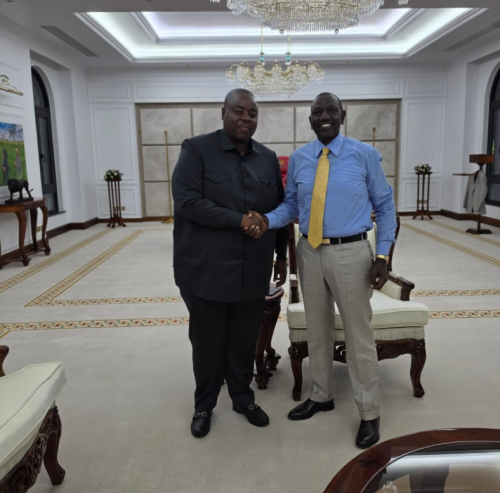
Uganda also became part of that network.
Chivayo publicly documented a meeting with President Yoweri Museveni at State House in Uganda. In his account of the meeting, he said Museveni discussed Uganda’s development plans and listened to proposals involving telecommunications and digital technology investment.
Read Also: 20 Fascinating Facts You Didn't Know About Africa’s Richest Man Aliko Dangote
The Mail & Guardian later identified Chivayo among businessmen who had gained access to several African leaders, including Museveni, Samia and Ruto.
Did Chivayo hold political power?
Not in the formal sense.
There is no public evidence that Chivayo served as an elected politician, Cabinet member or government official in Kenya, Uganda or Tanzania.
His influence was therefore better understood as access rather than constitutional authority.
He could reach senior political leaders, appear in presidential spaces and publicly discuss investment opportunities with people at the highest levels of government.
That type of access can be valuable for a businessman operating in sectors such as infrastructure, energy and telecommunications, where governments often play a major role in approving, financing or regulating projects.
But access alone does not prove that a businessman controls government decisions.
The reasons for many of Chivayo’s meetings were also not independently documented beyond what he or those around him disclosed publicly.
Mail & Guardian noted that the exact purpose of several presidential encounters remained unclear beyond photographs, social media posts and limited descriptions.
Why did his access attract attention?
Chivayo’s profile sat at the intersection of money, government projects and political power.
That naturally made his repeated access to presidents a subject of scrutiny.
In Kenya, questions intensified when his name became linked in media reports to discussions around major infrastructure projects, including the planned expansion of Jomo Kenyatta International Airport.
The Kenyan government later rejected reports that a Chivayo-linked company had bid for the JKIA contract.
That distinction matters.
Chivayo’s documented relationships with senior leaders are real. But not every commercial or political allegation attached to those relationships has been established.
What is clear is that he managed to build a regional network unusual for a private businessman.
From Harare to Nairobi, Kampala and Dar es Salaam, Chivayo moved comfortably in spaces normally associated with presidents, ministers and senior officials.
His rise in East African political circles was therefore not based on elected office.
It was built through business, personal relationships, high-level access and an ability to turn those encounters into a highly visible public brand.