
Why Sifuna’s Linda Mwananchi Name Could Complicate Ruto’s 2027 Strategy
The Political Parties Disputes Tribunal has handed Nairobi Senator Edwin Sifuna and his allies an important legal victory in their bid to turn Linda Mwananchi from a political movement into a formal electoral vehicle, a development that could complicate President William Ruto’s 2027 strategy, even as opposition fragmentation remains a major uncertainty.
The Tribunal on Wednesday, September 30, 2026, set aside the Registrar of Political Parties’ August 7, 2026 decision rejecting the reservation of the proposed Linda Mwananchi Movement name and directed the Registrar to reconsider the application in accordance with the law and communicate its position within seven days.
The ruling also removed a significant legal obstacle created by the competing Liberty National Democratic Alliance (LINDA) application. The Tribunal struck out LINDA’s pleadings after finding that the entity had not completed registration and therefore lacked legal capacity to participate in proceedings in its own name.
“We further find that not being a fully registered party, the interested party cannot sue, be sued, or participate in proceedings in its own name as it has no legal capacity,” the Tribunal ruled.
For Sifuna, the significance goes beyond the party-registration dispute. Linda Mwananchi now has a clearer path to acquiring a formal political identity at a time when the opposition is searching for a structure capable of competing with Ruto’s established political machine.

The name itself is part of the politics
“Linda Mwananchi” essentially protects the citizen, gives Sifuna a political message that is easy to understand and potentially broader than an ordinary party label.
The movement has increasingly presented itself as a people-centred alternative to the government, while Sifuna has become one of Ruto’s most visible political critics.
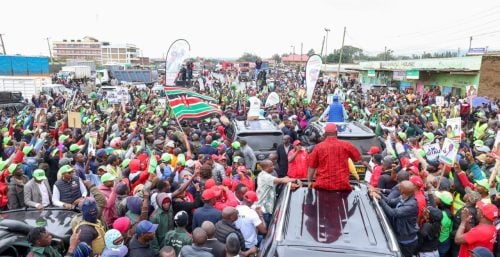
That confrontation was evident in September during a dispute over affordable housing. Speaking at a Linda Mwananchi rally at Nairobi’s Jacaranda Grounds, Sifuna told the President: “Mr William Ruto, the slums in Nairobi are not a housing problem; they are an income problem.”
Ruto answered two days later in Kisumu: “Let me enlighten you: yes, Kenya’s problem is income, but housing is what gives us employment.”
The exchange illustrates the political value of the Linda Mwananchi brand. Sifuna is not merely criticising individual government programmes; he is attempting to frame the wider political argument around household incomes, government accountability and the interests of ordinary citizens.

TIFA numbers give Sifuna’s rise context
The strongest evidence that Linda Mwananchi could matter politically comes from TIFA Research’s June 2026 national survey.
Among ODM supporters, 74 per cent identified with the Linda Mwananchi grouping, compared with 20 per cent who identified with the rival Linda Ground/Tuko Tayari position. That represented a slight increase from 73 per cent for Linda Mwananchi in May.
More broadly, TIFA recorded Sifuna at 15 per cent when respondents were asked whom they would prefer to win the 2027 presidential election. Ruto stood at 24 per cent, Fred Matiang’i at 14 per cent, Kalonzo Musyoka at 13 per cent and Rigathi Gachagua at seven per cent. Twenty per cent were undecided.
TIFA said Sifuna recorded the fastest growth among the leading opposition figures, rising from 10 per cent in May to 15 per cent in June.
Those figures do not establish that Sifuna can defeat Ruto, nor do they amount to an election forecast. The survey was conducted from June 13 to 22, before several subsequent political developments. Its significance is that it captured Sifuna emerging as a nationally recognised political figure while the opposition vote remained divided.
The sample comprised 2,048 adults across all 47 counties and had a reported national margin of error of ±2.18 per cent. TIFA cautioned that the findings were a snapshot and that alliances and candidate choices could change before 2027.

Sifuna’s opportunity and the problem for the opposition
TIFA’s findings reveal both sides of the equation. Among Kenyans who oppose Ruto’s re-election, 62 per cent said Gachagua should support another opposition candidate rather than necessarily lead the ticket. Only 14 per cent preferred Gachagua as the principal opposition candidate.
That suggests there is an appetite in the opposition electorate for some form of coordination.
But coordination is precisely where Linda Mwananchi faces its biggest test.
Sifuna’s emergence has occurred alongside the presidential ambitions of Matiang’i, Kalonzo and Gachagua. Each has a political base, while ODM itself remains divided over its future direction.
Political analyst Macharia Munene has identified Sifuna as one of the figures capable of becoming an important factor in the opposition’s attempt to unite. He argued that Sifuna’s strength could make him useful in coalition negotiations even if he did not ultimately occupy the top of the ticket.
That possibility means Linda Mwananchi could function in two ways: as a vehicle for Sifuna’s own national ambitions and as a bargaining platform in negotiations over a wider opposition coalition.
Read Also: Babu Owino's The Mwananchi Party Receives ORPP Certificate of Change of Name
Ruto’s challenge is therefore organisational, not simply numerical, as the Tribunal ruling does not create votes for Linda Mwananchi. Nor does TIFA’s polling establish that Sifuna’s support will continue rising.
What it does show is a political movement acquiring organisational space at precisely the moment the opposition is looking for a credible structure.
TIFA found that ODM had the highest party-identification level in June at 20 per cent, compared with 17 per cent for UDA, while 28 per cent of Kenyans did not identify with any political party.
That 28 per cent is particularly important. It indicates that a large share of the electorate was not yet attached to an established party when TIFA conducted its survey.
Linda Mwananchi therefore enters a political environment where established party loyalties are significant but far from universal.
Its biggest opportunity is also its biggest test: converting a recognisable slogan and Sifuna’s rising profile into a durable national organisation capable of working with other opposition formations.
For Ruto, the development is consequently best understood not as proof of an electoral setback, but as another complication in an increasingly fluid 2027 contest.
The President currently leads the individual presidential preference measure in TIFA’s June survey at 24 per cent, but the opposition support behind Sifuna, Matiang’i, Kalonzo and Gachagua remains dispersed.
The Tribunal ruling changes one part of that equation: Linda Mwananchi now has a clearer legal route to becoming a political vehicle.
Whether it becomes a standalone party, the nucleus of a wider coalition, or primarily a platform for Sifuna’s national ambitions will depend on the negotiations and political choices still to come.